
Macro economic environment in India is expected to improve further and drive the BSE index, Sensex, to 33,500 by December-end.
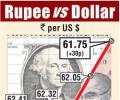
The rupee resumed higher at 61.75 as against the last closing level of 62.05 per dollar at the Interbank Foreign Exchange (Forex) Market and firmed up further to a one-month high of 61.53 before quoting at 61.59 per dollar at 1045 hours.
Markets will remain closed on Thursday, 12 November 2015 on account of Diwali Balipratipada.

The V-shaped rebound has been aided by a gush of liquidity flooding the global financial system, thanks to balance sheet expansion.

With a rise of around 30 per cent in the benchmark index S&P BSE Sensex, 2014 has been the best year for Indian equity markets since 2009, when the benchmark index surged 81 per cent.

In India elections are never fought in a straight line. It's fought on many issues, at many levels, with multiple emotions and with a bit of good luck, too. Sheela Bhatt reports from Rajasthan.

Markets will be closed on Thursday and Friday on account of Holi and Good Friday, respectively.

The sharp rally in the broader markets has propelled India's market capitalisation (m-cap) to a new high. The combined m-cap of all BSE-listed firms rose to Rs 291.9 trillion in intraday trade on Thursday before settling lower at Rs 290.9 trillion. The previous record was on December 14, 2022, at Rs 291.3 trillion.

On the Sensex chart, IndusInd Bank was the top gainer, rallying over 11 per cent, followed by ICICI Bank, SBI, HDFC, M&M and Axis Bank. On the other hand, Dr Reddy's, Tech Mahindra and TCS were among the laggards.

'It will be best for investors to have a systematic investment plan in mid-cap and small-cap funds with a three-/five-year horizon.'

Out of 11 companies that got listed in 2019, nine have outrun the market by gaining more than 10 per cent against their respective issue price.

When there is panic, you get an opportunity to get your hands on some of the good stocks.

Bharti Airtel was the top loser in the Sensex pack, falling over 3 per cent, followed by Bajaj Finance, PowerGrid, SBI, HDFC Bank and Sun Pharma. HCL Tech was the top gainer, rallying around 10 per cent. TCS, Infosys, Tech Mahindra and Titan too ended with up to 5 per cent gains.
Investors' wealth has jumped Rs 9,57,201.52 crore in the last three days of rally in equity market as stocks continued to march higher amid the Budget-led euphoria. The 30-share BSE benchmark on Wednesday zoomed 695.76 points or 1.18 per cent to settle at 59,558.33 as the post-Budget rally continued. This is the third day of rally in equities and helped by the optimism, the market capitalisation of BSE-listed companies jumped Rs 9,57,201.52 crore to Rs 2,70,64,905.75 crore in three days.

The introduction of GST would constitute India's biggest reform.

Stockmarket Gurus Raamdeo Agrawal, Manish Gunwani, S Naren and Nilesh Shah discuss their favourite themes for the New Year.

The one-year returns for equity-oriented mutual fund (MFs) schemes have largely mirrored the gains made in the secondary market. However, schemes that invest in infrastructure (infra), small-cap, and public sector undertaking (PSU) banks have emerged standout performers, with gains in excess of 100 per cent in some cases. Of the total 484 equity schemes, 353 have managed to beat the Sensex, reveals the data provided by Value Research. Around 20 have delivered returns in excess of 90 per cent and six schemes have given returns of over 100 per cent in the past one year. The S&P BSE Sensex Total Return Index (TRI) has given returns of 51 per cent in the last one year, ended October 29.

We need to give a booster shot to all our frontline workers first as if they fall victim to Omicron, the health system will collapse, points out Ramesh Menon.

Indian market probably has more headroom than the US, says Geoff Lewis, senior strategist for Asia, Manulife Asset Management.

Domestic-focused agricultural chemical (agrochem) companies could face near-term headwinds, given the worries on the El Nio effect on monsoons, higher inventory, and pressure on margins. Some of these were reflected in the October-December quarter (third quarter, or Q3) results of companies and may impact them in the current quarter (fourth quarter, or Q4) as well. Nuvama Research pointed out that the sector witnessed mixed performance during the quarter as global agrochem and domestic fertiliser companies maintained growth momentum, while adverse agronomical conditions and excess channel inventory weighed on domestic market volume offtake.
Domestic equity benchmarks ended marginally higher on Thursday, with the Nifty settling at a fresh record, amid mixed cues from global markets.

The gap between the highs and the lows in April for the benchmark S&P BSE Sensex was just 4.1 per cent - the narrowest since July 2021 and nearly half its three-year average. The absence of major positive triggers, sectoral rotation, and cautiousness due to earnings and economic uncertainty have kept a tight leash on the markets, observe experts. Remarkably enough, during the 17 trading sessions in April, the Sensex didn't even log an advance or a decline of more than 1 per cent.
Asset Management Companies (AMCs) demonstrated improved business metrics in the first quarter ended June 2023 (Q1FY24), but a sharp run-up in stocks leaves little room for further upside in the immediate term, say analysts. During this quarter, HDFC AMC reported a 10 per cent year-on-year (YoY) rise in revenue from operations at Rs 575 crore. Nippon India's revenue from operations went up 12 per cent to Rs 354 crore.

Since March 31, 2022, the PSBs' market cap has risen 43.7 per cent, from Rs. 7.29 trillion to Rs. 10.47 trillion. It's time for the government, the majority owner of public sector banks, to reap the benefit of the rally in bank stocks, recommends Tamal Bandyopadhyay.

Even as the Indian benchmarks, the BSE Sensex and Nifty 50, crumbled over three per cent today, experts are optimistic about the Indian economy and believe investors can still make 30 per cent plus returns in 2015

Maruti Suzuki, Asian Paints, L&T, ONGC and Infosys have gained between 1%-1.5%.

The company's market valuation stood at Rs 10,972 crore in morning trade.

Equity markets braved all odds this fiscal and rewarded investors with high returns as the benchmark Sensex surged more than 66 per cent despite COVID-led disruptions and concerns over its impact on the economy. Market analysts termed FY 2020-21 as a roller coaster ride for not only Indian markets but also for equity indices globally due to the pandemic. In an unprecedented come back, the 30-share BSE Sensex has jumped 19,540.01 points or 66.30 per cent so far this fiscal. This extraordinary rally holds significance as markets faced volatile trends this fiscal.

'...over the long-term can be done only by investing in equities.' 'And during weak macros, one needs t1o allocate more than drawing it down, because they offer the best entry point.'

Among the Sensex firms, Kotak Mahindra Bank, Tata Steel, ITC, ICICI Bank, Bajaj Finserv, Maruti, Mahindra & Mahindra and State Bank of India were the biggest winners. Tata Consultancy Services, Infosys, HCL Technologies, Tech Mahindra, Asian Paints, Wipro and Tata Motors were the biggest laggards.

The outbreak of the Omicron variant of the coronavirus and unprecedented lockdowns in China have roiled its equity market and also that of Hong Kong. After the crisis-hit Sri Lanka, China and Hong Kong are the worst-performing stock markets in Asia on a year-to-date basis.


Trading in Samvat 2074 on Thursday got off to a rocky start, with the benchmark indices ending more than half a percent lower and the gauge for banking stocks dropping 1.25%.

The IPO boom in 2023 added four new promoters to the billionaires' list.
We take a closer look at the recent stock market trend and ascertain whether there is something to worry.\n\n\n\n

Given the macro setting, the outlook remains positive for each of the four key parameters - inflation, current account deficit, fiscal deficit and currency stability, says Rahul Bhushkute.
Plans disinvestment in IOC and Coal India.

The total market valuation of the BSE-listed companies surged to an all-time high of Rs 107 lakh crore on Thursday.

Sensex up just 6.5% while the best returns were during Manmohan Singh, with the Sensex soaring nearly 167.5%.

Shares of small-cap companies have been on a roll with the S&P BSE Small-Cap index hitting a new high in intra-day deals on Thursday. The rally has been fueled by an up move in stocks of chemicals, cement, graphite electrode makers, pharmaceuticals and information technology (IT) shares. In the past two weeks, since March 25, the index has outperformed the market by gaining 7.3 per cent. In comparison, the S&P BSE Midcap index was up 6.1 per cent, while the S&P BSE Sensex gained 3.6 per cent during the same period.
